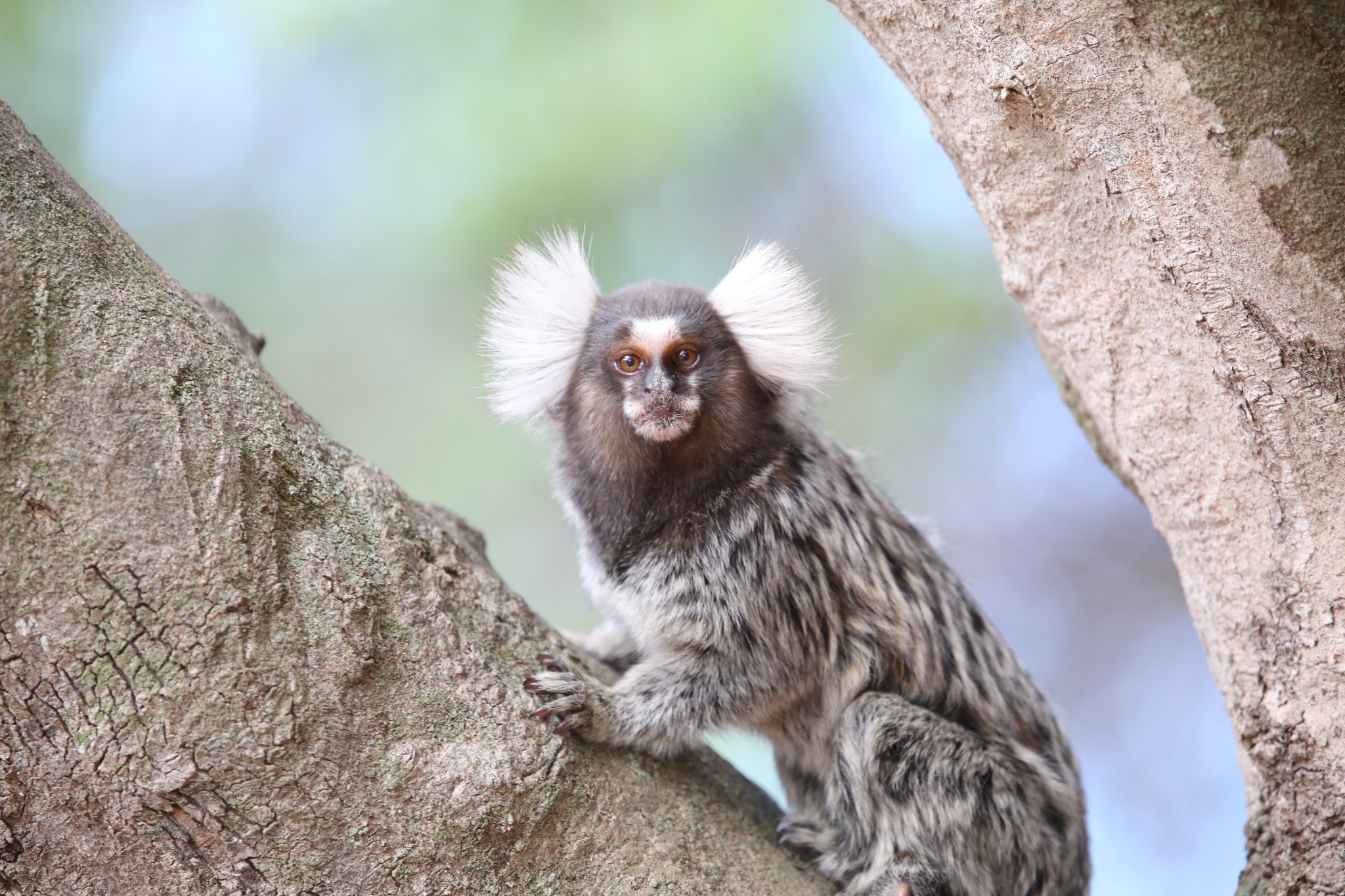
The question
Nearly everything we know about the primate visual cortex comes from experiments in which an animal’s head is held still while it looks at images on a screen. But that’s not how we see the world. In everyday life, we constantly move our eyes and head, rapidly shifting our gaze from one place to another.
So how does the visual cortex work when a primate is actually moving and looking around naturally?
How we did it
We developed a head-mounted eye-tracking system that allowed us to know exactly where freely moving marmosets were looking while simultaneously recording individual neurons in primary visual cortex (V1). We also tracked the animals’ heads and bodies and recorded the visual scene in front of them.
That let us reconstruct what a particular visual neuron was “seeing” as an animal naturally explored its environment.
What we found
Natural vision has a striking rhythm. When marmosets rapidly redirected their gaze, activity in V1 was suppressed. When their gaze landed and stabilized, activity was enhanced. These reflected two distinct stages associated with shifting and then fixing gaze.
When we repeated the experiment in complete darkness, these responses largely disappeared, showing that activity in primate V1 during natural gaze is driven predominantly by the changing visual information reaching the eyes rather than simply by signals that the animal moved.
We could also predict how strongly neurons responded from the visual information falling within their receptive fields, and larger gaze shifts changed the relationship between successive visual inputs and the response that followed.
Why it matters
Clinical vision is often assessed by asking whether a person can detect or identify something while looking straight ahead. But everyday vision depends on repeatedly moving the eyes and head, selecting new information, and integrating what is seen across those movements. Neurological injury and disease can disrupt this active process even when basic visual sensitivity remains relatively intact.
By establishing how visual cortex operates during natural gaze, this work provides a baseline for identifying when that brain–behavior loop is altered. In the long term, such measurements could contribute to more naturalistic assessments of visual dysfunction and recovery—testing not only what a patient can see in a static task, but how effectively the brain acquires and uses visual information while actively exploring the world.