Brains in the Real World
Brains evolved in the real world.
Brains evolved to allow animals to survive and thrive in complex, constantly changing environments—to find food, avoid danger, navigate through space, communicate with others, and make decisions about what to do next.
Yet understanding how the brain accomplishes these things presents a fundamental challenge. The brain contains billions of interconnected cells whose activity changes from moment to moment. To make this complexity experimentally tractable, neuroscience has traditionally simplified behavior. Animals might look at images on a screen, respond to individual sounds, or perform the same carefully controlled task hundreds of times.
These approaches have taught us an enormous amount about the brain. But they also leave an important question unanswered:
How does the brain work when we are doing the things the brain actually evolved to do?
That question is at the center of our research.
Natural behavior isn't noise.
Imagine walking through a crowded room while searching for a friend.
Your eyes move several times each second. Your head and body are moving. People appear and disappear from view. Multiple conversations overlap. You recognize familiar voices, remember where people are located, navigate around obstacles, and continuously adjust your behavior as the situation changes.
From an experimental perspective, this is messy.
From the brain's perspective, this is the challenge it evolved to solve. And it is remarkably good at solving it.
COMMUNICATION
How does the brain recognize another individual's voice, follow a conversation, and decide when to respond?
SOCIAL SPACE
How does the brain keep track of where we are and where other individuals are around us?
VISION
How does the brain construct our visual experience of the world?
The behaviors an animal performs provide clues about the computations its nervous system evolved to carry out. Rather than treating the complexity of natural behavior solely as something that needs to be eliminated experimentally, we can use that complexity to discover aspects of neural function that might otherwise remain hidden. Modern technology is making this increasingly possible.
Bringing neuroscience into the real world.
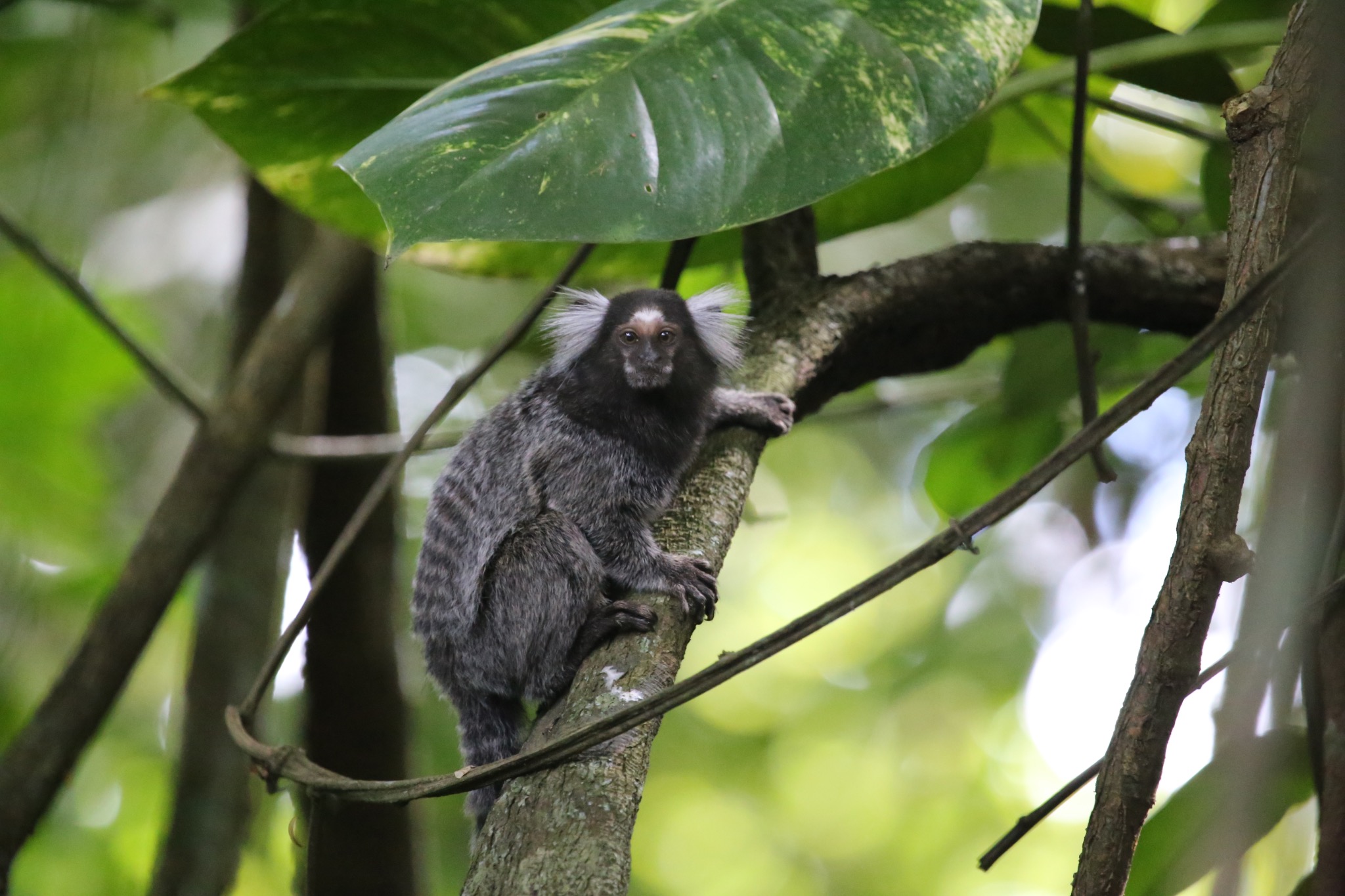
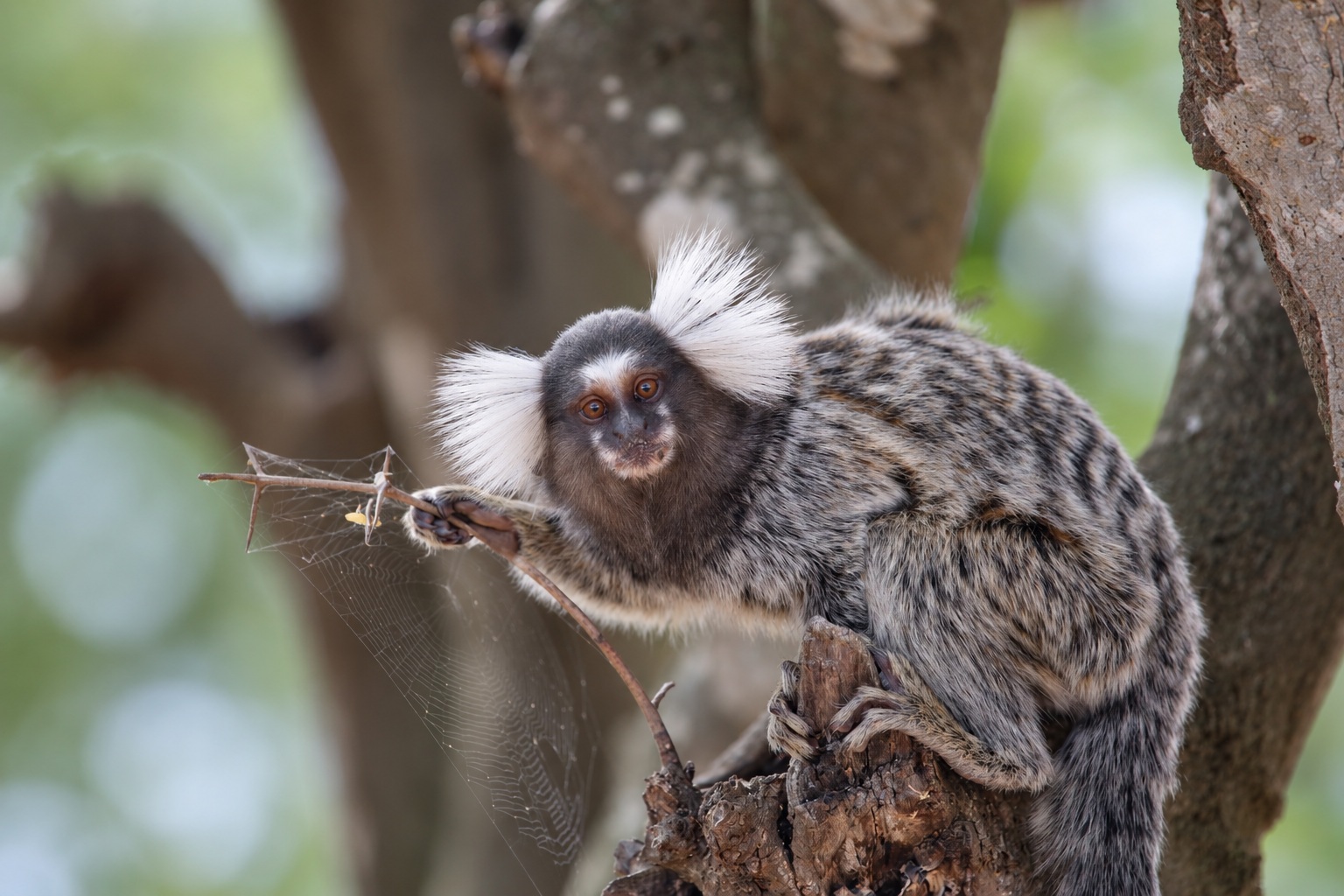
Our research starts in the wild.
We study marmosets in their natural habitat in Brazil to understand how they behave in the environments in which their brains evolved. Observations of wild marmosets—how they move through the forest, search for food, communicate, interact socially, and respond to a constantly changing environment—provide the foundation for the experimental approaches we develop in the laboratory.
The goal is not to recreate the forest inside the laboratory. Instead, we use observations of natural behavior to identify the problems marmoset brains actually evolved to solve, and then develop experiments that allow us to investigate the neural mechanisms underlying those behaviors.
Traditional neuroscience experiments gain experimental control partly by restricting movement and simplifying the environment. Our goal is to retain scientific rigor while allowing animals to engage in increasingly natural behavior.
That requires developing new tools. We use miniature eye-tracking systems to measure exactly where an animal is looking as it moves through its environment. Motion-capture systems measure where the animal's head and body are in three-dimensional space. Wireless and high-density neural recording technologies allow us to monitor the activity of populations of neurons during behavior.
At any instant, we can ask where an animal was, where it was looking, what it was hearing, who else was nearby, what had just happened—and what neurons across the brain were doing at that same moment.
From natural behavior, to neural mechanisms, to a deeper understanding of the human brain in health and disease.
That is the broader goal of the Cortical Systems and Behavior Lab: to understand how brains work in the world they evolved to navigate.
From understanding brains to improving human health.
Other animal species, cellular systems, and computational models each provide powerful ways to answer particular scientific questions. But they cannot reproduce every feature of the human brain. When the biology or behavior we need to understand depends on characteristics of the primate brain, studying another primate can provide the closest experimental model of the corresponding human system.
A neurological or psychiatric treatment ultimately succeeds because it improves someone's ability to function in everyday life—not simply because it changes a molecule, cell, or neural circuit. Disorders of the brain manifest themselves in the real world: in how people see, navigate, remember, communicate, make decisions, and interact socially.
Studying brains alone therefore isn't enough. We also need to understand primate brains doing the kinds of things brains evolved to do—to more accurately identify how those processes are altered by disease.
By studying how primate neural circuits operate during increasingly natural behavior, we can connect changes at the level of cells and circuits to changes in perception, cognition, and behavior.
Why Primates?
Ultimately, the most important reason to understand the brain is to improve human health.
Neurological and neuropsychiatric diseases and disorders affect the very functions that make us who we are—how we perceive the world, remember, communicate, make decisions, and interact with other people. Developing effective treatments requires understanding not only the cells and molecules of the brain, but how neural circuits work together to produce these complex behaviors.
For many of these questions, nonhuman primates provide our most accurate animal models of the human brain, behavior, and cognition. There is a simple reason for this:
Humans are primates.
We share a common evolutionary history and, as a result, core features of our brain architecture and neural mechanisms. We also share characteristic ways of perceiving and interacting with the world. Like humans, other primates rely heavily on vision, actively explore their surroundings with rapid eye movements, and use visual information to recognize individuals and interpret their actions. Primate social life depends on sophisticated social cognition: tracking individual identities and relationships, attending to the behavior and intentions of others, communicating with specific individuals, and adjusting behavior according to social context and past interactions. These are not inherently better or more complex than the adaptations found in other species; they reflect a distinctly primate combination of perception, cognition, and social behavior that provides important parallels to our own.
Why marmosets?
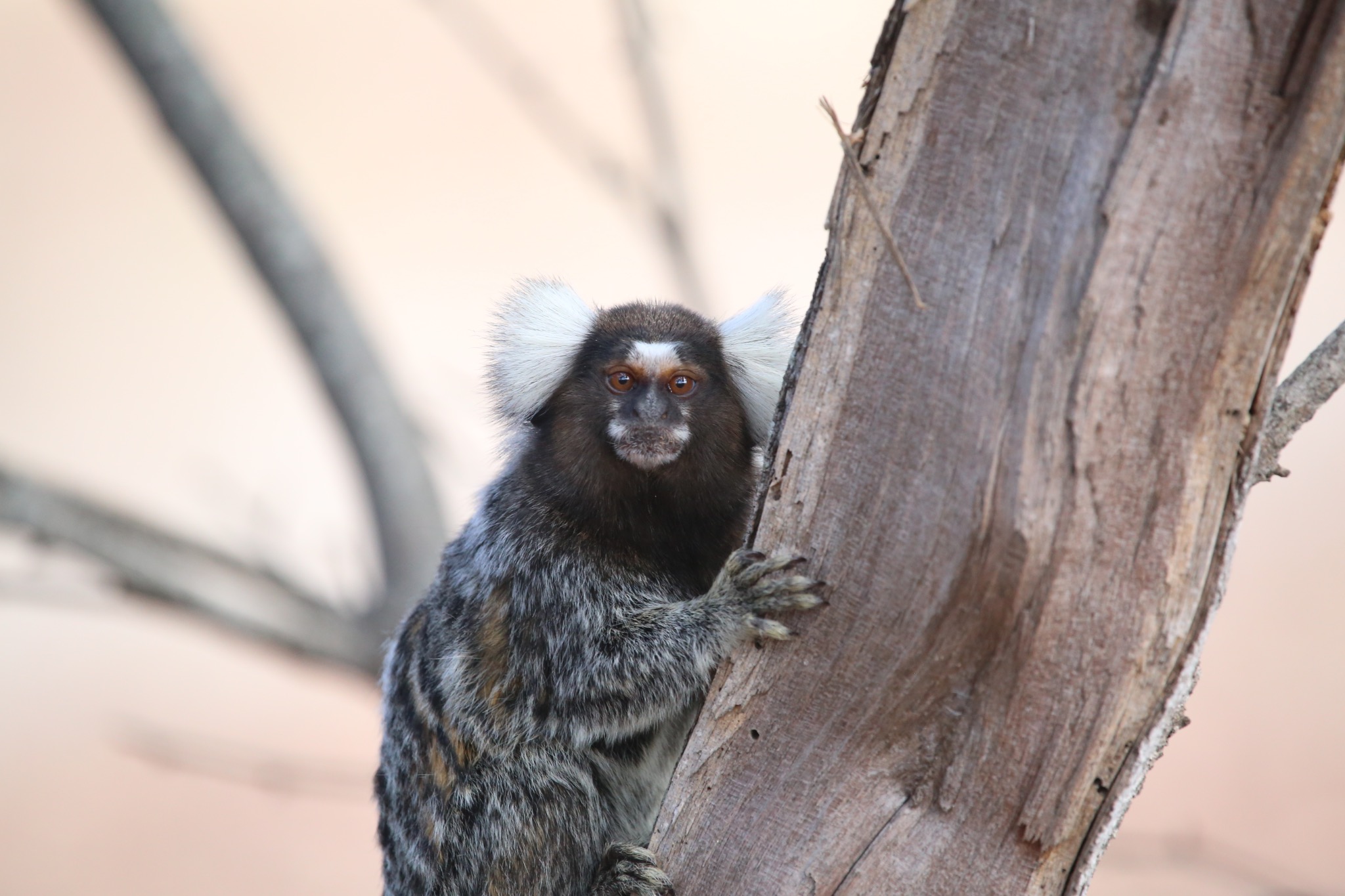
In our research we work with common marmosets, a small New World primate native to Brazil. Like us, marmosets are intensely social primates. They form long-term pair bonds, live in extended family groups, cooperatively care for their young, and exhibit forms of prosocial cognition in which individuals act in ways that benefit others. Their social lives depend on recognizing other individuals, remembering relationships, monitoring what others are doing, and coordinating their behavior with the members of their group.
Marmosets also communicate constantly. Individuals take turns during vocal exchanges, adjust their behavior according to who they are interacting with, and use communication to maintain relationships when other group members are out of sight. And, like humans and other primates, they rely heavily on vision to understand the world around them, actively directing their eyes, head, and body toward information that is important for what they are doing.
These similarities are important because humans are primates too. We share fundamental features of brain organization as well as core elements of perception, cognition, communication, and social behavior. The neural systems that allow primates to recognize individuals, navigate complex environments, communicate with others, form lasting social relationships, and make decisions within a social group have important parallels to those that support these abilities in humans.
This combination makes marmosets particularly valuable for our research. Their natural behavior brings together many of the processes that neuroscience has traditionally studied separately—perception, movement, memory, decision-making, communication, and social cognition. By studying these processes as animals naturally use them, we can investigate how the primate brain coordinates them to produce meaningful behavior in the real world.
And that provides an important bridge to understanding ourselves: how the same fundamental principles allow the human brain to perceive, communicate, remember, navigate, and participate in an extraordinarily complex social world.
Complementary models
Understanding the human brain requires many different experimental approaches.
New Approach Methodologies (NAMs)—including human cell and tissue models, organoids, computational (AI) models, and other emerging technologies—are creating powerful new ways to investigate biological mechanisms.
But NAMs and animal models answer different, complementary questions.
A cell culture, organoid, or computer model can isolate particular mechanisms with extraordinary precision, but it cannot yet reproduce the integrated activity of a living primate brain as it sees, moves, remembers, communicates, and interacts with other individuals.
The greatest opportunity comes from connecting these approaches rather than treating them as alternatives.
Discoveries made with NAMs can identify mechanisms and potential therapeutic targets that can then be tested within intact biological systems. Animal studies can reveal how those mechanisms operate across cells, circuits, organs, and behavior, generating new questions that can in turn be investigated using NAMs.
Related reading: America's Risky Retreat in Biomedical Leadership — Cory T. Miller, National Review (2025). READ THE ARTICLE →